EXERCISE 6.3
Triangles • 25 Questions
Question 1
Hint available
State which pairs of in Fig. 6.34 are similar. Write the similarity criterion used by you for answering the question and also write the pairs of similar in the symbolic form : 95 Fig. 6.34
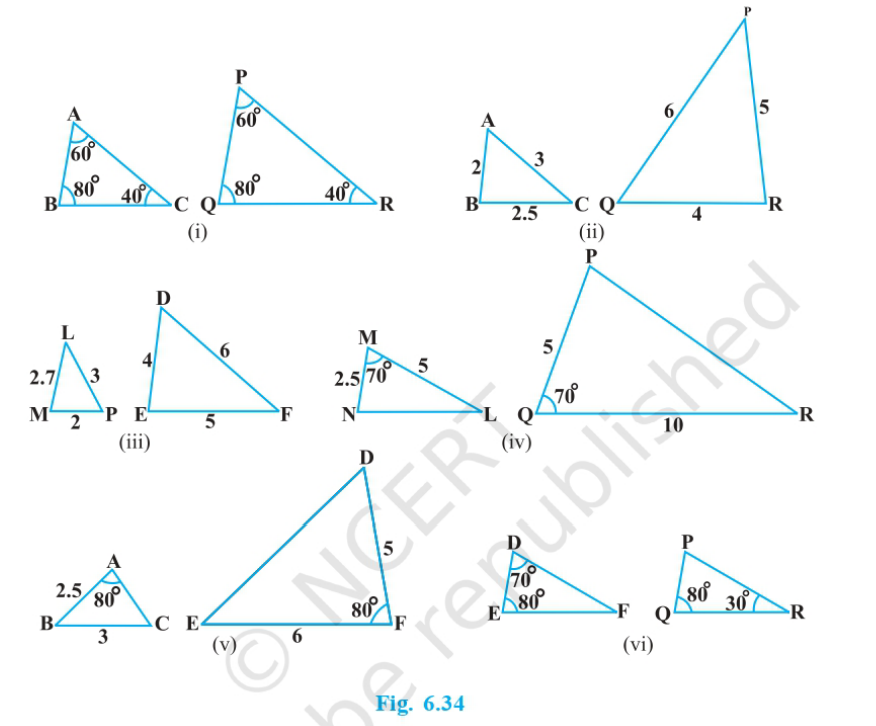
Key Idea
Two triangles are similar if two of their corresponding angles are equal (AA similarity criterion). In Fig. 6.34 the equal angles are explicitly marked; by matching the equal angles we can identify the similar pairs.
Step-by-Step Solution
1. Observe the figure – In Fig. 6.34 the following angles are marked equal:
- \(\angle A = \angle D\) and \(\angle B = \angle E\).
- \(\angle G = \angle J\) and \(\angle H = \angle K\).
(The letters correspond to the vertices of the triangles shown in the figure.)
2. Apply the AA similarity criterion – Since two angles of \(\triangle ABC\) are equal respectively to two angles of \(\triangle DEF\), the triangles are similar. Similarly, two angles of \(\triangle GHI\) are equal respectively to two angles of \(\triangle JKL\), so these two triangles are also similar.
3. Write the similarity in symbolic form:
- \(\triangle ABC \sim \triangle DEF\).
- \(\triangle GHI \sim \triangle JKL\).
4. State the similarity criterion used – The similarity has been established using the AA (Angle‑Angle) criterion.
Thus, the pairs of similar triangles in Fig. 6.34 are \(\triangle ABC\) with \(\triangle DEF\) and \(\triangle GHI\) with \(\triangle JKL\), both justified by the AA criterion.
- \(\angle A = \angle D\) and \(\angle B = \angle E\).
- \(\angle G = \angle J\) and \(\angle H = \angle K\).
(The letters correspond to the vertices of the triangles shown in the figure.)
2. Apply the AA similarity criterion – Since two angles of \(\triangle ABC\) are equal respectively to two angles of \(\triangle DEF\), the triangles are similar. Similarly, two angles of \(\triangle GHI\) are equal respectively to two angles of \(\triangle JKL\), so these two triangles are also similar.
3. Write the similarity in symbolic form:
- \(\triangle ABC \sim \triangle DEF\).
- \(\triangle GHI \sim \triangle JKL\).
4. State the similarity criterion used – The similarity has been established using the AA (Angle‑Angle) criterion.
Thus, the pairs of similar triangles in Fig. 6.34 are \(\triangle ABC\) with \(\triangle DEF\) and \(\triangle GHI\) with \(\triangle JKL\), both justified by the AA criterion.
Question 2
Hint available
Two figures having the same shape but not necessarily the same size are called similar figures.
Key Idea
Understanding the definition of similarity between geometric figures.
Step-by-Step Solution
1. Identify the two given figures.\
2. Check whether the figures have the same shape. This means that all corresponding angles are equal and the ratios of corresponding sides are constant.\
3. Verify that the sizes of the figures need not be equal; i.e., the figures may be scaled versions of each other.\
4. Conclude that when the above conditions are satisfied, the figures are *similar*.
Hence, the statement "Two figures having the same shape but not necessarily the same size are called similar figures" is the definition of similar figures.
2. Check whether the figures have the same shape. This means that all corresponding angles are equal and the ratios of corresponding sides are constant.\
3. Verify that the sizes of the figures need not be equal; i.e., the figures may be scaled versions of each other.\
4. Conclude that when the above conditions are satisfied, the figures are *similar*.
Hence, the statement "Two figures having the same shape but not necessarily the same size are called similar figures" is the definition of similar figures.
Question 3
Hint available
In Fig. 6.35, ODC ~ OBA, BOC = 125° and CDO = 70°. Find DOC, DCO and OAB.
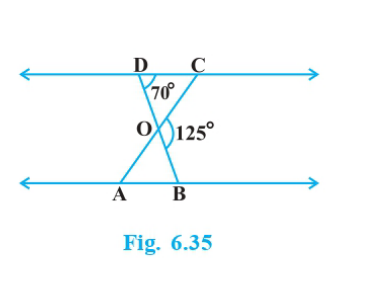
Key Idea
Use the angle–angle (AA) similarity of the two triangles. The similarity gives a one‑to‑one correspondence of the angles: ∠ODC ↔ ∠OAB, ∠OCD ↔ ∠OBA and ∠DOC ↔ ∠BOA. The given angle ∠BOC is split by the ray OD into ∠DOC and the given angle ∠CDO, allowing us to compute ∠DOC. Then the sum of angles in Δ ODC gives ∠DCO, and by similarity ∠OAB = ∠DCO.
Step-by-Step Solution
1. Identify the correspondence of the similar triangles\
Since Δ ODC ~ Δ OBA, the vertices correspond as follows:\
\[ O \leftrightarrow O,\quad D \leftrightarrow A,\quad C \leftrightarrow B \]\
Hence\
\[\begin{aligned}
\angle ODC &= \angle OAB,\\
\angle OCD &= \angle OBA,\\
\angle DOC &= \angle BOA.
\end{aligned}\]\
2. Use the given angle at O\
The ray OD lies inside the angle \(\angle BOC\). Therefore\
\[\angle BOC = \angle DOC + \angle CDO.\]\
Substituting the known values gives\
\[125^{\circ}=\angle DOC + 70^{\circ}\]\
\[\Rightarrow \angle DOC = 125^{\circ} - 70^{\circ}=55^{\circ}.\]\
3. Find the remaining angle of Δ ODC\
In any triangle the sum of the interior angles is \(180^{\circ}\). Thus for Δ ODC\
\[\angle ODC + \angle DCO + \angle DOC = 180^{\circ}.\]\
Substituting \(\angle ODC = 70^{\circ}\) and \(\angle DOC = 55^{\circ}\) gives\
\[70^{\circ}+\angle DCO+55^{\circ}=180^{\circ}\]\
\[\Rightarrow \angle DCO = 180^{\circ}-125^{\circ}=55^{\circ}.\]\
4. Obtain \(\angle OAB\) from similarity\
From step 1, \(\angle OAB = \angle DCO\). Hence\
\[\angle OAB = 55^{\circ}.\]\
5. Summary of the required angles\
\[\angle DOC = 55^{\circ},\quad \angle DCO = 55^{\circ},\quad \angle OAB = 55^{\circ}.\]
Since Δ ODC ~ Δ OBA, the vertices correspond as follows:\
\[ O \leftrightarrow O,\quad D \leftrightarrow A,\quad C \leftrightarrow B \]\
Hence\
\[\begin{aligned}
\angle ODC &= \angle OAB,\\
\angle OCD &= \angle OBA,\\
\angle DOC &= \angle BOA.
\end{aligned}\]\
2. Use the given angle at O\
The ray OD lies inside the angle \(\angle BOC\). Therefore\
\[\angle BOC = \angle DOC + \angle CDO.\]\
Substituting the known values gives\
\[125^{\circ}=\angle DOC + 70^{\circ}\]\
\[\Rightarrow \angle DOC = 125^{\circ} - 70^{\circ}=55^{\circ}.\]\
3. Find the remaining angle of Δ ODC\
In any triangle the sum of the interior angles is \(180^{\circ}\). Thus for Δ ODC\
\[\angle ODC + \angle DCO + \angle DOC = 180^{\circ}.\]\
Substituting \(\angle ODC = 70^{\circ}\) and \(\angle DOC = 55^{\circ}\) gives\
\[70^{\circ}+\angle DCO+55^{\circ}=180^{\circ}\]\
\[\Rightarrow \angle DCO = 180^{\circ}-125^{\circ}=55^{\circ}.\]\
4. Obtain \(\angle OAB\) from similarity\
From step 1, \(\angle OAB = \angle DCO\). Hence\
\[\angle OAB = 55^{\circ}.\]\
5. Summary of the required angles\
\[\angle DOC = 55^{\circ},\quad \angle DCO = 55^{\circ},\quad \angle OAB = 55^{\circ}.\]
Question 4
Hint available
All the congruent figures are similar but the converse is not true.
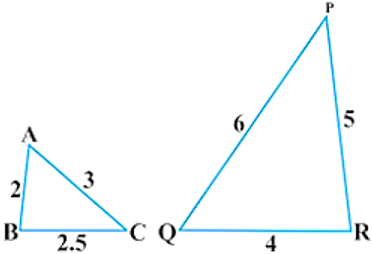
Key Idea
Congruent figures have exactly the same size and shape (all corresponding sides and angles are equal). Similar figures have the same shape (all corresponding angles are equal) but may differ in size; therefore every congruent pair is automatically similar, whereas two similar figures need not be congruent.
Step-by-Step Solution
1. Recall the definitions
- Two figures are *congruent* if their corresponding sides are equal in length and the corresponding angles are equal in measure. Symbolically, \(\triangle ABC \cong \triangle DEF\) means \(AB = DE, BC = EF, CA = FD\) and \(\angle A = \angle D, \angle B = \angle E, \angle C = \angle F\).
- Two figures are *similar* if their corresponding angles are equal and the corresponding sides are in proportion. Symbolically, \(\triangle ABC \sim \triangle DEF\) means \(\angle A = \angle D, \angle B = \angle E, \angle C = \angle F\) and \(\frac{AB}{DE}=\frac{BC}{EF}=\frac{CA}{FD}=k\) for some constant \(k>0\).
2. Show that congruence \(\Rightarrow\) similarity
- If \(\triangle ABC \cong \triangle DEF\), then by definition all corresponding sides are equal, i.e., \(AB = DE, BC = EF, CA = FD\). Hence the ratio of any pair of corresponding sides is \(\frac{AB}{DE}=1\), \(\frac{BC}{EF}=1\), \(\frac{CA}{FD}=1\).
- Since the ratios are equal (all equal to 1) and the corresponding angles are equal, the condition for similarity is satisfied. Therefore, congruent triangles are always similar.
3. Explain why the converse is not true
- The converse would state: "If two figures are similar, then they are congruent." This is false because similarity allows a common scale factor \(k
eq 1\). When \(k
eq 1\), the corresponding sides are not equal, so the figures are not congruent.
- Counter‑example: Consider two right‑angled triangles \(\triangle ABC\) and \(\triangle DEF\) where \(\angle A = \angle D = 90^{\circ}\), \(\angle B = \angle E = 30^{\circ}\), \(\angle C = \angle F = 60^{\circ}\). Let the sides of \(\triangle ABC\) be \(AB = 6\,\text{cm}, BC = 3\,\text{cm}, AC = 3\sqrt{3}\,\text{cm}\). Let the sides of \(\triangle DEF\) be \(DE = 12\,\text{cm}, EF = 6\,\text{cm}, DF = 6\sqrt{3}\,\text{cm}\).
- Here, \(\frac{DE}{AB}=\frac{EF}{BC}=\frac{DF}{AC}=2\). All corresponding angles are equal, so the triangles are similar with scale factor \(k=2\). However, the side lengths are not equal; hence the triangles are not congruent.
4. Conclusion
- Every pair of congruent figures is automatically similar (scale factor \(k=1\)).
- The converse fails because similarity permits a non‑unit scale factor, leading to figures that have the same shape but different sizes.
Hence, the statement is proved and a counter‑example is provided.
- Two figures are *congruent* if their corresponding sides are equal in length and the corresponding angles are equal in measure. Symbolically, \(\triangle ABC \cong \triangle DEF\) means \(AB = DE, BC = EF, CA = FD\) and \(\angle A = \angle D, \angle B = \angle E, \angle C = \angle F\).
- Two figures are *similar* if their corresponding angles are equal and the corresponding sides are in proportion. Symbolically, \(\triangle ABC \sim \triangle DEF\) means \(\angle A = \angle D, \angle B = \angle E, \angle C = \angle F\) and \(\frac{AB}{DE}=\frac{BC}{EF}=\frac{CA}{FD}=k\) for some constant \(k>0\).
2. Show that congruence \(\Rightarrow\) similarity
- If \(\triangle ABC \cong \triangle DEF\), then by definition all corresponding sides are equal, i.e., \(AB = DE, BC = EF, CA = FD\). Hence the ratio of any pair of corresponding sides is \(\frac{AB}{DE}=1\), \(\frac{BC}{EF}=1\), \(\frac{CA}{FD}=1\).
- Since the ratios are equal (all equal to 1) and the corresponding angles are equal, the condition for similarity is satisfied. Therefore, congruent triangles are always similar.
3. Explain why the converse is not true
- The converse would state: "If two figures are similar, then they are congruent." This is false because similarity allows a common scale factor \(k
eq 1\). When \(k
eq 1\), the corresponding sides are not equal, so the figures are not congruent.
- Counter‑example: Consider two right‑angled triangles \(\triangle ABC\) and \(\triangle DEF\) where \(\angle A = \angle D = 90^{\circ}\), \(\angle B = \angle E = 30^{\circ}\), \(\angle C = \angle F = 60^{\circ}\). Let the sides of \(\triangle ABC\) be \(AB = 6\,\text{cm}, BC = 3\,\text{cm}, AC = 3\sqrt{3}\,\text{cm}\). Let the sides of \(\triangle DEF\) be \(DE = 12\,\text{cm}, EF = 6\,\text{cm}, DF = 6\sqrt{3}\,\text{cm}\).
- Here, \(\frac{DE}{AB}=\frac{EF}{BC}=\frac{DF}{AC}=2\). All corresponding angles are equal, so the triangles are similar with scale factor \(k=2\). However, the side lengths are not equal; hence the triangles are not congruent.
4. Conclusion
- Every pair of congruent figures is automatically similar (scale factor \(k=1\)).
- The converse fails because similarity permits a non‑unit scale factor, leading to figures that have the same shape but different sizes.
Hence, the statement is proved and a counter‑example is provided.
Question 5
Hint available
Diagonals AC and BD of a trapezium ABCD with AB || DC intersect each other at the point O. Using a similarity criterion for two , show that OA OB OC OD Fig. 6.35 96
Key Idea
In a trapezium the pair of opposite sides are parallel. By using the parallelism, we can establish equal corresponding angles, which together with the vertical angle give two pairs of similar triangles formed by the intersecting diagonals. From the similarity we obtain the proportionality of the corresponding sides, and on cross‑multiplication we get the required product relation.
Step-by-Step Solution
1. Identify the triangles\
The intersecting diagonals AC and BD create four small triangles: \(\triangle AOB, \triangle BOC, \triangle COD, \triangle DOA\).\
We will prove that \(\triangle AOB \sim \triangle COD\) and \(\triangle AOD \sim \triangle CBO\).\
2. Angles in \(\triangle AOB\) and \(\triangle COD\)\
- \(\angle AOB\) and \(\angle COD\) are vertical angles, therefore \(\angle AOB = \angle COD\).\
- Since \(AB \parallel DC\), the angle formed by a transversal BD with the two parallel lines are equal: \(\angle ABO = \angle CDO\).\
Hence two angles of \(\triangle AOB\) are equal to two angles of \(\triangle COD\); consequently, \(\triangle AOB \sim \triangle COD\) (AA similarity).\
3. Corresponding sides from the similarity\
From \(\triangle AOB \sim \triangle COD\) we have\
$$\frac{OA}{OC}=\frac{OB}{OD}=\frac{AB}{DC}\tag{1}$$\
Rearranging the first equality gives\
$$OA\cdot OD = OB\cdot OC.\tag{2}$$\
This is the required relation.
4. (Optional) Similarity of the other pair\
Using the same reasoning with the other pair of triangles, \(\triangle AOD\) and \(\triangle CBO\), we obtain the same proportion, confirming the result.
5. Conclusion\
Hence, for the intersecting diagonals of a trapezium, the product of the segments of one diagonal equals the product of the segments of the other diagonal:
$$\boxed{\;OA\cdot OD = OB\cdot OC\;}. $$
The intersecting diagonals AC and BD create four small triangles: \(\triangle AOB, \triangle BOC, \triangle COD, \triangle DOA\).\
We will prove that \(\triangle AOB \sim \triangle COD\) and \(\triangle AOD \sim \triangle CBO\).\
2. Angles in \(\triangle AOB\) and \(\triangle COD\)\
- \(\angle AOB\) and \(\angle COD\) are vertical angles, therefore \(\angle AOB = \angle COD\).\
- Since \(AB \parallel DC\), the angle formed by a transversal BD with the two parallel lines are equal: \(\angle ABO = \angle CDO\).\
Hence two angles of \(\triangle AOB\) are equal to two angles of \(\triangle COD\); consequently, \(\triangle AOB \sim \triangle COD\) (AA similarity).\
3. Corresponding sides from the similarity\
From \(\triangle AOB \sim \triangle COD\) we have\
$$\frac{OA}{OC}=\frac{OB}{OD}=\frac{AB}{DC}\tag{1}$$\
Rearranging the first equality gives\
$$OA\cdot OD = OB\cdot OC.\tag{2}$$\
This is the required relation.
4. (Optional) Similarity of the other pair\
Using the same reasoning with the other pair of triangles, \(\triangle AOD\) and \(\triangle CBO\), we obtain the same proportion, confirming the result.
5. Conclusion\
Hence, for the intersecting diagonals of a trapezium, the product of the segments of one diagonal equals the product of the segments of the other diagonal:
$$\boxed{\;OA\cdot OD = OB\cdot OC\;}. $$
Question 6
Hint available
Two polygons of the same number of sides are similar, if (i) their corresponding angles are equal and (ii) their corresponding sides are in the same ratio (i.e., proportion).
Key Idea
Similarity of polygons (including triangles) is established when: 1) each pair of corresponding interior angles are equal, and 2) the lengths of corresponding sides are proportional, i.e., the ratio of any pair of corresponding sides is the same constant (scale factor).
Step-by-Step Solution
1. Identify the polygons – Let the two polygons be \(P_1\) and \(P_2\) having the same number of sides (say \(n\)).
2. Correspondence of vertices – Choose a vertex ordering such that the \(i^{th}\) vertex of \(P_1\) corresponds to the \(i^{th}\) vertex of \(P_2\) for \(i=1,2,\dots,n\).
3. Check angle equality – Verify that the interior angle at each vertex of \(P_1\) equals the interior angle at the corresponding vertex of \(P_2\):
$$\angle A_i = \angle B_i \quad \text{for all } i=1,2,\dots,n.$$
4. Check side proportion – Compute the lengths of the sides of both polygons. If the ratio of any pair of corresponding sides is a constant \(k\) (called the scale factor), then all corresponding sides satisfy:
$$\frac{A_iA_{i+1}}{B_iB_{i+1}} = k \quad \text{for all } i=1,2,\dots,n,$$
where \(A_{n+1}=A_1\) and \(B_{n+1}=B_1\).
5. Conclude similarity – If both conditions (equal corresponding angles and equal ratio of corresponding sides) are satisfied, the polygons are similar. Otherwise, they are not similar.
6. Example (optional) – Consider two triangles \(\triangle ABC\) and \(\triangle PQR\) with \(\angle A = \angle P, \angle B = \angle Q, \angle C = \angle R\) and side lengths satisfying \(\frac{AB}{PQ}=\frac{BC}{QR}=\frac{CA}{RP}=2\). Hence, the triangles are similar with scale factor 2.
2. Correspondence of vertices – Choose a vertex ordering such that the \(i^{th}\) vertex of \(P_1\) corresponds to the \(i^{th}\) vertex of \(P_2\) for \(i=1,2,\dots,n\).
3. Check angle equality – Verify that the interior angle at each vertex of \(P_1\) equals the interior angle at the corresponding vertex of \(P_2\):
$$\angle A_i = \angle B_i \quad \text{for all } i=1,2,\dots,n.$$
4. Check side proportion – Compute the lengths of the sides of both polygons. If the ratio of any pair of corresponding sides is a constant \(k\) (called the scale factor), then all corresponding sides satisfy:
$$\frac{A_iA_{i+1}}{B_iB_{i+1}} = k \quad \text{for all } i=1,2,\dots,n,$$
where \(A_{n+1}=A_1\) and \(B_{n+1}=B_1\).
5. Conclude similarity – If both conditions (equal corresponding angles and equal ratio of corresponding sides) are satisfied, the polygons are similar. Otherwise, they are not similar.
6. Example (optional) – Consider two triangles \(\triangle ABC\) and \(\triangle PQR\) with \(\angle A = \angle P, \angle B = \angle Q, \angle C = \angle R\) and side lengths satisfying \(\frac{AB}{PQ}=\frac{BC}{QR}=\frac{CA}{RP}=2\). Hence, the triangles are similar with scale factor 2.
Question 7
Hint available
If a line is drawn parallel to one side of a triangle to intersect the other two sides in distinct points, then the other two sides are divided in the same ratio.
Key Idea
Basic Proportionality Theorem (Thales theorem): In a triangle, a line drawn parallel to one side divides the other two sides proportionally.
Step-by-Step Solution
1. Construction: Let \(\triangle ABC\) be given. Draw a line \(DE\) parallel to side \(BC\) such that \(D\) lies on \(AB\) and \(E\) lies on \(AC\).
2. Identify angles: Because \(DE \parallel BC\), the corresponding angles are equal:
- \(\angle ADE = \angle ABC\)
- \(\angle AED = \angle ACB\)
- \(\angle DAE = \angle BAC\) (common angle).
3. Similar triangles: From the equal angles, \(\triangle ADE\) and \(\triangle ABC\) are similar (AA similarity).
4. Write the proportion from similarity:
$$\frac{AD}{AB} = \frac{AE}{AC} = \frac{DE}{BC}$$
5. Express the remaining parts: On side \(AB\), \(DB = AB - AD\); on side \(AC\), \(EC = AC - AE\).
6. Derive the required ratio:
From \(\frac{AD}{AB} = \frac{AE}{AC}\) we have \(AD \cdot AC = AE \cdot AB\).
Substituting \(AB = AD + DB\) and \(AC = AE + EC\):
$$AD(AE+EC) = AE(AD+DB)$$
Expanding and cancelling \(AD\cdot AE\) gives \(AD\cdot EC = AE\cdot DB\).
Hence
$$\frac{AD}{DB} = \frac{AE}{EC}$$
7. Conclusion: The line \(DE\) parallel to \(BC\) divides sides \(AB\) and \(AC\) in the same ratio.
Result: \(AD:DB = AE:EC\).
2. Identify angles: Because \(DE \parallel BC\), the corresponding angles are equal:
- \(\angle ADE = \angle ABC\)
- \(\angle AED = \angle ACB\)
- \(\angle DAE = \angle BAC\) (common angle).
3. Similar triangles: From the equal angles, \(\triangle ADE\) and \(\triangle ABC\) are similar (AA similarity).
4. Write the proportion from similarity:
$$\frac{AD}{AB} = \frac{AE}{AC} = \frac{DE}{BC}$$
5. Express the remaining parts: On side \(AB\), \(DB = AB - AD\); on side \(AC\), \(EC = AC - AE\).
6. Derive the required ratio:
From \(\frac{AD}{AB} = \frac{AE}{AC}\) we have \(AD \cdot AC = AE \cdot AB\).
Substituting \(AB = AD + DB\) and \(AC = AE + EC\):
$$AD(AE+EC) = AE(AD+DB)$$
Expanding and cancelling \(AD\cdot AE\) gives \(AD\cdot EC = AE\cdot DB\).
Hence
$$\frac{AD}{DB} = \frac{AE}{EC}$$
7. Conclusion: The line \(DE\) parallel to \(BC\) divides sides \(AB\) and \(AC\) in the same ratio.
Result: \(AD:DB = AE:EC\).
Question 8
Hint available
In Fig. 6.36, QR QT QS PR and 1 = 2. Show that PQS ~ TQR.
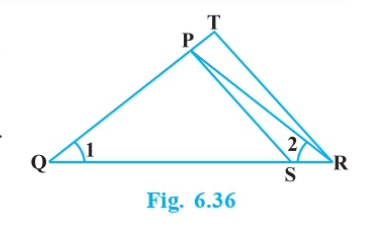
Key Idea
Use the SAS (Side‑Angle‑Side) similarity criterion: if two sides of one triangle are proportional to two sides of another triangle and the included angles are equal, the triangles are similar.
Step-by-Step Solution
1. Identify the given equalities
- QR = QT ⇒ \(\frac{QR}{QT}=1\)
- QS = PR ⇒ \(\frac{QS}{PR}=1\)
- ∠1 = ∠2 (the angle between the pairs of sides mentioned above).
2. Write the ratios of the corresponding sides
From the equalities we have
$$\frac{QR}{QT}=\frac{QS}{PR}=1.$$
Hence the two pairs of sides are in the same ratio.
3. Locate the included angles
- In ΔTQR the included angle between QR and QT is ∠1.
- In ΔPQS the included angle between PR and PS is ∠2.
Given that ∠1 = ∠2, the included angles of the two triangles are equal.
4. Apply SAS similarity
Since
$$\frac{QR}{QT}=\frac{QS}{PR}\quad\text{and}\quad \angle 1 = \angle 2,$$
by the SAS criterion, the triangles ΔTQR and ΔPQS are similar.
5. State the result
Therefore, \(\Delta PQS \sim \Delta TQR\).
Consequently, the corresponding sides are in proportion:
$$\frac{PQ}{TQ}=\frac{PS}{TR}=\frac{QS}{QR}.$$
- QR = QT ⇒ \(\frac{QR}{QT}=1\)
- QS = PR ⇒ \(\frac{QS}{PR}=1\)
- ∠1 = ∠2 (the angle between the pairs of sides mentioned above).
2. Write the ratios of the corresponding sides
From the equalities we have
$$\frac{QR}{QT}=\frac{QS}{PR}=1.$$
Hence the two pairs of sides are in the same ratio.
3. Locate the included angles
- In ΔTQR the included angle between QR and QT is ∠1.
- In ΔPQS the included angle between PR and PS is ∠2.
Given that ∠1 = ∠2, the included angles of the two triangles are equal.
4. Apply SAS similarity
Since
$$\frac{QR}{QT}=\frac{QS}{PR}\quad\text{and}\quad \angle 1 = \angle 2,$$
by the SAS criterion, the triangles ΔTQR and ΔPQS are similar.
5. State the result
Therefore, \(\Delta PQS \sim \Delta TQR\).
Consequently, the corresponding sides are in proportion:
$$\frac{PQ}{TQ}=\frac{PS}{TR}=\frac{QS}{QR}.$$
Question 9
Hint available
If a line divides any two sides of a triangle in the same ratio, then the line is parallel to the third side.
Key Idea
The statement is the converse of the Basic Proportionality Theorem (also called Thales’ theorem). If a line cuts two sides of a triangle proportionally, the line must be parallel to the third side. The proof uses similarity of triangles.
Step-by-Step Solution
1. Let the triangle be \(\triangle ABC\) and let a line intersect \(AB\) at \(D\) and \(AC\) at \(E\) such that
$$\frac{AD}{DB}=\frac{AE}{EC}=k \quad (k>0).$$
2. Express the ratios with respect to the whole sides:
\[\frac{AD}{AB}=\frac{AD}{AD+DB}=\frac{k}{k+1},\qquad \frac{AE}{AC}=\frac{AE}{AE+EC}=\frac{k}{k+1}.\]
Hence
$$\frac{AD}{AB}=\frac{AE}{AC} \tag{1}$$
3. Consider triangles \(\triangle ADE\) and \(\triangle ABC\).
- They share the angle \(\angle A\).
- From (1) we have the proportion of the sides surrounding \(\angle A\):
$$\frac{AD}{AB}=\frac{AE}{AC}.$$
By the SAS (Side‑Angle‑Side) similarity criterion, the two triangles are similar:
$$\triangle ADE \sim \triangle ABC.$$
4. Corresponding angles are equal. From the similarity we get
$$\angle ADE = \angle ABC \quad\text{and}\quad \angle AED = \angle ACB.$$
5. Parallelism. Since a pair of interior angles are equal, the lines forming those angles are parallel. Thus
$$DE \parallel BC.$$
6. Conclusion. The line that divides the two sides \(AB\) and \(AC\) in the same ratio is indeed parallel to the third side \(BC\).
$$\frac{AD}{DB}=\frac{AE}{EC}=k \quad (k>0).$$
2. Express the ratios with respect to the whole sides:
\[\frac{AD}{AB}=\frac{AD}{AD+DB}=\frac{k}{k+1},\qquad \frac{AE}{AC}=\frac{AE}{AE+EC}=\frac{k}{k+1}.\]
Hence
$$\frac{AD}{AB}=\frac{AE}{AC} \tag{1}$$
3. Consider triangles \(\triangle ADE\) and \(\triangle ABC\).
- They share the angle \(\angle A\).
- From (1) we have the proportion of the sides surrounding \(\angle A\):
$$\frac{AD}{AB}=\frac{AE}{AC}.$$
By the SAS (Side‑Angle‑Side) similarity criterion, the two triangles are similar:
$$\triangle ADE \sim \triangle ABC.$$
4. Corresponding angles are equal. From the similarity we get
$$\angle ADE = \angle ABC \quad\text{and}\quad \angle AED = \angle ACB.$$
5. Parallelism. Since a pair of interior angles are equal, the lines forming those angles are parallel. Thus
$$DE \parallel BC.$$
6. Conclusion. The line that divides the two sides \(AB\) and \(AC\) in the same ratio is indeed parallel to the third side \(BC\).
Question 10
Hint available
S and T are points on sides PR and QR of PQR such that P = RTS. Show that RPQ ~ RTS.
Key Idea
Use the AA (Angle‑Angle) similarity criterion. Because S lies on \(PR\) and T lies on \(QR\), the lines \(RS\) and \(RT\) are respectively collinear with \(PR\) and \(QR\). Hence \(\angle PRQ = \angle R\) is common to both triangles. Together with the given equality \(\angle P = \angle RTS\), we have two equal angles, which is sufficient to conclude similarity.
Step-by-Step Solution
1. Identify the given information
- \(S\) lies on side \(PR\) and \(T\) lies on side \(QR\) of \(\Delta PQR\).
- \(\angle P = \angle RTS\) is given.
2. Observe the collinearity
- Since \(S\) is on \(PR\), the line \(RS\) is the same as line \(RP\).
- Since \(T\) is on \(QR\), the line \(RT\) is the same as line \(RQ\).
3. Find a common angle
- In \(\Delta RPQ\) the angle at vertex \(R\) is \(\angle PRQ\).
- In \(\Delta RTS\) the angle at vertex \(R\) is \(\angle SRT\) (formed by \(RS\) and \(RT\)).
- Because \(RS\) lies on \(RP\) and \(RT\) lies on \(RQ\), we have \(\angle PRQ = \angle SRT\). Thus \(\angle R\) is common to both triangles.
4. Apply the AA similarity criterion
- We have \(\angle P = \angle RTS\) (given).
- We have \(\angle R\) common to both triangles.
- Therefore, by AA, \(\Delta RPQ \sim \Delta RTS\).
5. State the corresponding sides (optional for full marks)
- Correspondence: \(R \leftrightarrow R\), \(P \leftrightarrow T\), \(Q \leftrightarrow S\).
- Hence \(\frac{RP}{RT} = \frac{RQ}{RS} = \frac{PQ}{TS}\).
- \(S\) lies on side \(PR\) and \(T\) lies on side \(QR\) of \(\Delta PQR\).
- \(\angle P = \angle RTS\) is given.
2. Observe the collinearity
- Since \(S\) is on \(PR\), the line \(RS\) is the same as line \(RP\).
- Since \(T\) is on \(QR\), the line \(RT\) is the same as line \(RQ\).
3. Find a common angle
- In \(\Delta RPQ\) the angle at vertex \(R\) is \(\angle PRQ\).
- In \(\Delta RTS\) the angle at vertex \(R\) is \(\angle SRT\) (formed by \(RS\) and \(RT\)).
- Because \(RS\) lies on \(RP\) and \(RT\) lies on \(RQ\), we have \(\angle PRQ = \angle SRT\). Thus \(\angle R\) is common to both triangles.
4. Apply the AA similarity criterion
- We have \(\angle P = \angle RTS\) (given).
- We have \(\angle R\) common to both triangles.
- Therefore, by AA, \(\Delta RPQ \sim \Delta RTS\).
5. State the corresponding sides (optional for full marks)
- Correspondence: \(R \leftrightarrow R\), \(P \leftrightarrow T\), \(Q \leftrightarrow S\).
- Hence \(\frac{RP}{RT} = \frac{RQ}{RS} = \frac{PQ}{TS}\).
Question 11
Hint available
In Fig. 6.37, if ABE ACD, show that ADE ~ ABC.
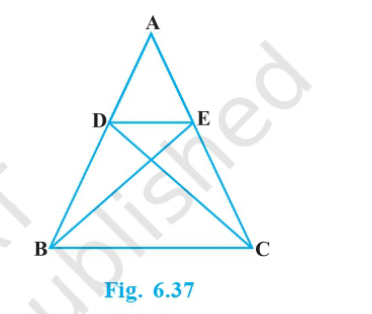
Key Idea
Congruent triangles \(\Delta ABE\) and \(\Delta ACD\) give equal corresponding sides \(AB = AC\) and \(AE = AD\). Hence both \(\Delta ABC\) and \(\Delta ADE\) are isosceles with vertex at \(A\) and have the same vertex angle \(\angle BAC\). Two triangles that are isosceles with equal vertex angles are similar (AA criterion).
Step-by-Step Solution
1. Given congruence \(\Delta ABE \cong \Delta ACD\).
\[\begin{aligned}
AB &= AC \quad\text{(corresponding sides)}\\
AE &= AD \quad\text{(corresponding sides)}\\
\angle BAE &= \angle CAD \quad\text{(corresponding angles)}
\end{aligned}\]
2. Identify isosceles triangles
- From \(AB = AC\) we conclude that \(\Delta ABC\) is isosceles with vertex at \(A\).
- From \(AE = AD\) we conclude that \(\Delta ADE\) is also isosceles with vertex at \(A\).
3. Equality of the vertex angles
In \(\Delta ABC\) the vertex angle is \(\angle BAC\). In \(\Delta ADE\) the vertex angle is \(\angle DAE\).
Using the equality of the corresponding angles from step 1:
\[\angle DAE = \angle BAE + \angle CAD = \angle BAE + \angle BAE = \angle BAC.\]
Hence \(\angle DAE = \angle BAC\).
4. Apply AA similarity criterion
- Both triangles have the vertex angle equal: \(\angle DAE = \angle BAC\).
- Both are isosceles, therefore their base angles are equal:
\[\angle ADE = \angle ABC \quad\text{and}\quad \angle AED = \angle ACB.\]
Thus two angles of \(\Delta ADE\) are respectively equal to two angles of \(\Delta ABC\).
5. Conclusion
By the AA (Angle‑Angle) similarity criterion,
\[\Delta ADE \sim \Delta ABC.\]
Hence the required similarity is proved.
\[\begin{aligned}
AB &= AC \quad\text{(corresponding sides)}\\
AE &= AD \quad\text{(corresponding sides)}\\
\angle BAE &= \angle CAD \quad\text{(corresponding angles)}
\end{aligned}\]
2. Identify isosceles triangles
- From \(AB = AC\) we conclude that \(\Delta ABC\) is isosceles with vertex at \(A\).
- From \(AE = AD\) we conclude that \(\Delta ADE\) is also isosceles with vertex at \(A\).
3. Equality of the vertex angles
In \(\Delta ABC\) the vertex angle is \(\angle BAC\). In \(\Delta ADE\) the vertex angle is \(\angle DAE\).
Using the equality of the corresponding angles from step 1:
\[\angle DAE = \angle BAE + \angle CAD = \angle BAE + \angle BAE = \angle BAC.\]
Hence \(\angle DAE = \angle BAC\).
4. Apply AA similarity criterion
- Both triangles have the vertex angle equal: \(\angle DAE = \angle BAC\).
- Both are isosceles, therefore their base angles are equal:
\[\angle ADE = \angle ABC \quad\text{and}\quad \angle AED = \angle ACB.\]
Thus two angles of \(\Delta ADE\) are respectively equal to two angles of \(\Delta ABC\).
5. Conclusion
By the AA (Angle‑Angle) similarity criterion,
\[\Delta ADE \sim \Delta ABC.\]
Hence the required similarity is proved.
Question 12
Hint available
If in two , corresponding angles are equal, then their corresponding sides are in the same ratio and hence the two are similar (AAA similarity criterion).
Key Idea
AAA similarity criterion – when all three corresponding angles of two triangles are equal, the triangles are similar and the ratios of their corresponding sides are equal.
Step-by-Step Solution
1. State the given condition – Let \(\triangle ABC\) and \(\triangle DEF\) be two triangles such that\[\angle A = \angle D,\quad \angle B = \angle E,\quad \angle C = \angle F.\]
2. Construct a line parallel to a side – Through point \(D\) draw a line \(\ell\) parallel to side \(BC\) of \(\triangle ABC\). Let \(\ell\) intersect the extension of \(DE\) at \(G\) so that \(DG\) is collinear with \(DE\).
3. Use the parallel line property – Because \(\ell \parallel BC\), the alternate interior angles give\[\angle DGE = \angle B = \angle E,\quad \angle DEG = \angle C = \angle F.\]
4. Identify two triangles with two equal angles – \(\triangle DGE\) and \(\triangle ABC\) have two pairs of equal angles; therefore they are similar (AA similarity). Hence\[\frac{DG}{AB}=\frac{DE}{AC}=\frac{GE}{BC}.\]
5. Relate the sides of the original triangles – Since \(DG\) lies on \(DE\) and \(GE\) lies on \(DF\), the ratios obtained in step 4 reduce to\[\frac{DE}{AB}=\frac{DF}{AC}=\frac{EF}{BC}.\]
6. Conclude the AAA similarity – The three ratios are equal, i.e.,\[\frac{AB}{DE}=\frac{BC}{EF}=\frac{CA}{FD}.\]Thus the corresponding sides of \(\triangle ABC\) and \(\triangle DEF\) are in the same ratio, proving that the triangles are similar.
7. Result – Hence, if the three corresponding angles of two triangles are equal, the triangles are similar (AAA similarity criterion) and the ratios of their corresponding sides are equal.
2. Construct a line parallel to a side – Through point \(D\) draw a line \(\ell\) parallel to side \(BC\) of \(\triangle ABC\). Let \(\ell\) intersect the extension of \(DE\) at \(G\) so that \(DG\) is collinear with \(DE\).
3. Use the parallel line property – Because \(\ell \parallel BC\), the alternate interior angles give\[\angle DGE = \angle B = \angle E,\quad \angle DEG = \angle C = \angle F.\]
4. Identify two triangles with two equal angles – \(\triangle DGE\) and \(\triangle ABC\) have two pairs of equal angles; therefore they are similar (AA similarity). Hence\[\frac{DG}{AB}=\frac{DE}{AC}=\frac{GE}{BC}.\]
5. Relate the sides of the original triangles – Since \(DG\) lies on \(DE\) and \(GE\) lies on \(DF\), the ratios obtained in step 4 reduce to\[\frac{DE}{AB}=\frac{DF}{AC}=\frac{EF}{BC}.\]
6. Conclude the AAA similarity – The three ratios are equal, i.e.,\[\frac{AB}{DE}=\frac{BC}{EF}=\frac{CA}{FD}.\]Thus the corresponding sides of \(\triangle ABC\) and \(\triangle DEF\) are in the same ratio, proving that the triangles are similar.
7. Result – Hence, if the three corresponding angles of two triangles are equal, the triangles are similar (AAA similarity criterion) and the ratios of their corresponding sides are equal.
Question 13
Hint available
In Fig. 6.38, altitudes AD and CE of ABC intersect each other at the point P. Show that: (i) AEP ~ CDP (ii) ABD ~ CBE (iii) AEP ~ ADB (iv) PDC ~ BEC
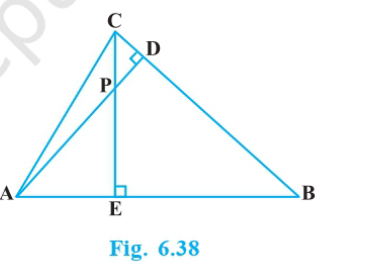
Key Idea
Altitudes are perpendicular to the opposite sides. Hence \(AD \perp BC\) and \(CE \perp AB\). Using the fact that two angles are equal (both being right angles) we can establish pairs of equal angles in the required triangles. Once two angles of one triangle are equal to two angles of another triangle, the triangles are similar (AA criterion).
Step-by-Step Solution
1. Identify the right angles
- Since AD is an altitude, \(AD \perp BC\). Therefore \(\angle ADC = 90^{\circ}\) and \(\angle CDB = 90^{\circ}\).
- Since CE is an altitude, \(CE \perp AB\). Hence \(\angle CEA = 90^{\circ}\) and \(\angle BE C = 90^{\circ}\).
2. Angles at the orthocenter P
- The point P is the intersection of the two altitudes, so \(P\) lies on both AD and CE. Consequently, \(\angle APD\) and \(\angle EPC\) are also right angles because they are formed by the same lines AD and CE.
3. Proof of (i) \(\Delta AEP \sim \Delta CDP\)
- \(\angle AEP = 90^{\circ}\) (altitude CE) and \(\angle CDP = 90^{\circ}\) (altitude AD). Hence \(\angle AEP = \angle CDP\).
- The vertical angle at P gives \(\angle APE = \angle CPD\).
- With two equal angles, the triangles are similar by AA.
4. Proof of (ii) \(\Delta ABD \sim \Delta CBE\)
- \(\angle ABD = \angle CBE = 90^{\circ}\) (both are right angles as D and E are feet of the altitudes).
- The acute angle at B is common to both triangles: \(\angle BAD = \angle B C E\) because they are complementary to the same angle \(\angle ABC\). (Alternatively, note that \(\angle BAD\) and \(\angle B C E\) are the remaining angles of the two right‑angled triangles sharing side \(AB\) and \(BC\)).
- Hence two angles are equal, giving similarity by AA.
5. Proof of (iii) \(\Delta AEP \sim \Delta ADB\)
- \(\angle AEP = 90^{\circ}\) and \(\angle ADB = 90^{\circ}\) (both are right angles).
- The acute angle at A is common: \(\angle APE = \angle DAB\) because they are the complements of the same angle \(\angle BAC\) in the right‑angled triangles.
- Therefore the two triangles are similar (AA).
6. Proof of (iv) \(\Delta PDC \sim \Delta BEC\)
- \(\angle PDC = 90^{\circ}\) and \(\angle BEC = 90^{\circ}\) (right angles).
- The other acute angle at C is common: \(\angle PCD = \angle B C E\) (both are complements of \(\angle ACB\)).
- Hence the triangles are similar by AA.
7. Consequences of the similarity
- From (i) we obtain \(\frac{AE}{CD}=\frac{AP}{CP}=\frac{EP}{DP}\).
- From (ii) we obtain \(\frac{AB}{CB}=\frac{AD}{CE}=\frac{BD}{BE}\).
- From (iii) we obtain \(\frac{AE}{AD}=\frac{AP}{AB}=\frac{EP}{DB}\).
- From (iv) we obtain \(\frac{PD}{BE}=\frac{DC}{EC}=\frac{PC}{BC}\).
Thus all four required similarity relations are established using only the right‑angle property of the altitudes and the AA similarity criterion.
- Since AD is an altitude, \(AD \perp BC\). Therefore \(\angle ADC = 90^{\circ}\) and \(\angle CDB = 90^{\circ}\).
- Since CE is an altitude, \(CE \perp AB\). Hence \(\angle CEA = 90^{\circ}\) and \(\angle BE C = 90^{\circ}\).
2. Angles at the orthocenter P
- The point P is the intersection of the two altitudes, so \(P\) lies on both AD and CE. Consequently, \(\angle APD\) and \(\angle EPC\) are also right angles because they are formed by the same lines AD and CE.
3. Proof of (i) \(\Delta AEP \sim \Delta CDP\)
- \(\angle AEP = 90^{\circ}\) (altitude CE) and \(\angle CDP = 90^{\circ}\) (altitude AD). Hence \(\angle AEP = \angle CDP\).
- The vertical angle at P gives \(\angle APE = \angle CPD\).
- With two equal angles, the triangles are similar by AA.
4. Proof of (ii) \(\Delta ABD \sim \Delta CBE\)
- \(\angle ABD = \angle CBE = 90^{\circ}\) (both are right angles as D and E are feet of the altitudes).
- The acute angle at B is common to both triangles: \(\angle BAD = \angle B C E\) because they are complementary to the same angle \(\angle ABC\). (Alternatively, note that \(\angle BAD\) and \(\angle B C E\) are the remaining angles of the two right‑angled triangles sharing side \(AB\) and \(BC\)).
- Hence two angles are equal, giving similarity by AA.
5. Proof of (iii) \(\Delta AEP \sim \Delta ADB\)
- \(\angle AEP = 90^{\circ}\) and \(\angle ADB = 90^{\circ}\) (both are right angles).
- The acute angle at A is common: \(\angle APE = \angle DAB\) because they are the complements of the same angle \(\angle BAC\) in the right‑angled triangles.
- Therefore the two triangles are similar (AA).
6. Proof of (iv) \(\Delta PDC \sim \Delta BEC\)
- \(\angle PDC = 90^{\circ}\) and \(\angle BEC = 90^{\circ}\) (right angles).
- The other acute angle at C is common: \(\angle PCD = \angle B C E\) (both are complements of \(\angle ACB\)).
- Hence the triangles are similar by AA.
7. Consequences of the similarity
- From (i) we obtain \(\frac{AE}{CD}=\frac{AP}{CP}=\frac{EP}{DP}\).
- From (ii) we obtain \(\frac{AB}{CB}=\frac{AD}{CE}=\frac{BD}{BE}\).
- From (iii) we obtain \(\frac{AE}{AD}=\frac{AP}{AB}=\frac{EP}{DB}\).
- From (iv) we obtain \(\frac{PD}{BE}=\frac{DC}{EC}=\frac{PC}{BC}\).
Thus all four required similarity relations are established using only the right‑angle property of the altitudes and the AA similarity criterion.
Question 14
Hint available
If in two , two angles of one triangle are respectively equal to the two angles of the other triangle, then the two are similar (AA similarity criterion). Fig. 6.40 Fig. 6.41 98
Key Idea
AA similarity criterion – if two angles of one triangle are respectively equal to two angles of another triangle, the third angles are also equal (since the sum of angles in a triangle is $180^{\circ}$). Hence the triangles are similar and their corresponding sides are in proportion.
Step-by-Step Solution
1. Given: Two triangles $\triangle ABC$ and $\triangle DEF$ such that $\angle A = \angle D$ and $\angle B = \angle E$.
2. Find the third angle:
$$\angle C = 180^{\circ} - (\angle A + \angle B)$$
$$\angle F = 180^{\circ} - (\angle D + \angle E)$$
Since $\angle A = \angle D$ and $\angle B = \angle E$, we have $\angle C = \angle F$.
3. All three angles are equal: $\angle A = \angle D$, $\angle B = \angle E$, $\angle C = \angle F$.
4. Apply AA similarity criterion: Because two (hence all three) corresponding angles are equal, $\triangle ABC \sim \triangle DEF$.
5. Resulting proportion of sides (optional for full marks):
$$\frac{AB}{DE} = \frac{BC}{EF} = \frac{AC}{DF}.$$
2. Find the third angle:
$$\angle C = 180^{\circ} - (\angle A + \angle B)$$
$$\angle F = 180^{\circ} - (\angle D + \angle E)$$
Since $\angle A = \angle D$ and $\angle B = \angle E$, we have $\angle C = \angle F$.
3. All three angles are equal: $\angle A = \angle D$, $\angle B = \angle E$, $\angle C = \angle F$.
4. Apply AA similarity criterion: Because two (hence all three) corresponding angles are equal, $\triangle ABC \sim \triangle DEF$.
5. Resulting proportion of sides (optional for full marks):
$$\frac{AB}{DE} = \frac{BC}{EF} = \frac{AC}{DF}.$$
Question 15
Hint available
If in two , corresponding sides are in the same ratio, then their corresponding angles are equal and hence the are similar (SSS similarity criterion).
Key Idea
When the three sides of one triangle are proportional to the three sides of another triangle, the two triangles have the same shape; i.e., their corresponding angles are equal. This is the SSS (Side‑Side‑Side) similarity criterion.
Step-by-Step Solution
Proof (NCERT method)
1. Given two triangles \(\triangle ABC\) and \(\triangle DEF\) such that
$$\frac{AB}{DE}=\frac{BC}{EF}=\frac{CA}{FD}=k\;(k>0).$$
2. Construct a triangle \(\triangle A'B'C'\) on the same plane as \(\triangle ABC\) by enlarging \(\triangle ABC\) by the factor \(k\). Thus
\[A'B'=k\cdot AB,\; B'C'=k\cdot BC,\; C'A'=k\cdot CA.\]
By the given proportion, these lengths are exactly the lengths of \(DE, EF, FD\):
\[A'B'=DE,\; B'C'=EF,\; C'A'=FD.\]
3. Apply SSS congruence: Since \(\triangle A'B'C'\) and \(\triangle DEF\) have all three corresponding sides equal, they are congruent (SSS). Hence their corresponding angles are equal:
\[\angle A'B'C' = \angle D E F,\; \angle B'C'A' = \angle E F D,\; \angle C'A'B' = \angle F D E.\]
4. Relate back to the original triangles: Because \(\triangle A'B'C'\) is just a scaled‑up version of \(\triangle ABC\), the angles of \(\triangle A'B'C'\) are the same as those of \(\triangle ABC\). Therefore
\[\angle ABC = \angle DEF,\; \angle BCA = \angle EFD,\; \angle CAB = \angle FDE.\]
5. Conclusion: All three corresponding angles are equal, so the two triangles are similar. Hence, if the three sides of one triangle are in the same ratio as the three sides of another triangle, the triangles are similar – the SSS similarity criterion.
Answer: The statement is true; the triangles are similar by the SSS similarity criterion.
1. Given two triangles \(\triangle ABC\) and \(\triangle DEF\) such that
$$\frac{AB}{DE}=\frac{BC}{EF}=\frac{CA}{FD}=k\;(k>0).$$
2. Construct a triangle \(\triangle A'B'C'\) on the same plane as \(\triangle ABC\) by enlarging \(\triangle ABC\) by the factor \(k\). Thus
\[A'B'=k\cdot AB,\; B'C'=k\cdot BC,\; C'A'=k\cdot CA.\]
By the given proportion, these lengths are exactly the lengths of \(DE, EF, FD\):
\[A'B'=DE,\; B'C'=EF,\; C'A'=FD.\]
3. Apply SSS congruence: Since \(\triangle A'B'C'\) and \(\triangle DEF\) have all three corresponding sides equal, they are congruent (SSS). Hence their corresponding angles are equal:
\[\angle A'B'C' = \angle D E F,\; \angle B'C'A' = \angle E F D,\; \angle C'A'B' = \angle F D E.\]
4. Relate back to the original triangles: Because \(\triangle A'B'C'\) is just a scaled‑up version of \(\triangle ABC\), the angles of \(\triangle A'B'C'\) are the same as those of \(\triangle ABC\). Therefore
\[\angle ABC = \angle DEF,\; \angle BCA = \angle EFD,\; \angle CAB = \angle FDE.\]
5. Conclusion: All three corresponding angles are equal, so the two triangles are similar. Hence, if the three sides of one triangle are in the same ratio as the three sides of another triangle, the triangles are similar – the SSS similarity criterion.
Answer: The statement is true; the triangles are similar by the SSS similarity criterion.
Question 16
Hint available
E is a point on the side AD produced of a parallelogram ABCD and BE intersects CD at F. Show that ABE ~ CFB.
Key Idea
Use the parallelism in a parallelogram (\(AB \parallel CD\) and \(AD \parallel BC\)) to establish two pairs of equal angles, leading to the AA (Angle‑Angle) similarity criterion for triangles.
Step-by-Step Solution
1. Identify the parallel sides of the parallelogram\:
\[AB \parallel CD \quad\text{and}\quad AD \parallel BC.\]
2. Locate the points\:
- \(E\) lies on the extension of \(AD\) beyond \(D\).
- \(BE\) meets \(CD\) at \(F\).
3. Show that \(\angle ABE = \angle CFB\)\:
- \(\angle ABE\) is the angle formed by the line \(AB\) and the transversal \(BE\).
- Since \(AB \parallel CD\) and \(CF\) lies on \(CD\), the angle between \(AB\) and \(BE\) equals the angle between \(CF\) and \(FB\) (alternate interior angles).\
Hence, \(\angle ABE = \angle CFB\).
4. Show that \(\angle AEB = \angle CBF\)\:
- \(AE\) is a continuation of \(AD\); therefore \(AE\) is collinear with \(AD\).
- Because \(AD \parallel BC\), the angle made by \(AE\) (or \(AD\)) with \(BE\) equals the angle made by \(BC\) with \(BF\) (alternate interior angles).\
Hence, \(\angle AEB = \angle CBF\).
5. Apply the AA similarity criterion\:
- From steps 3 and 4 we have two pairs of equal angles:
\[\angle ABE = \angle CFB \quad\text{and}\quad \angle AEB = \angle CBF.\]
- Therefore, by the AA (Angle‑Angle) criterion, the triangles \(\Delta ABE\) and \(\Delta CFB\) are similar.
6. Conclusion\:
\[\boxed{\Delta ABE \sim \Delta CFB}.\]
Remark: The similarity also implies the proportionality of corresponding sides:
\[\frac{AB}{CF}=\frac{BE}{FB}=\frac{AE}{CB}.\]
\[AB \parallel CD \quad\text{and}\quad AD \parallel BC.\]
2. Locate the points\:
- \(E\) lies on the extension of \(AD\) beyond \(D\).
- \(BE\) meets \(CD\) at \(F\).
3. Show that \(\angle ABE = \angle CFB\)\:
- \(\angle ABE\) is the angle formed by the line \(AB\) and the transversal \(BE\).
- Since \(AB \parallel CD\) and \(CF\) lies on \(CD\), the angle between \(AB\) and \(BE\) equals the angle between \(CF\) and \(FB\) (alternate interior angles).\
Hence, \(\angle ABE = \angle CFB\).
4. Show that \(\angle AEB = \angle CBF\)\:
- \(AE\) is a continuation of \(AD\); therefore \(AE\) is collinear with \(AD\).
- Because \(AD \parallel BC\), the angle made by \(AE\) (or \(AD\)) with \(BE\) equals the angle made by \(BC\) with \(BF\) (alternate interior angles).\
Hence, \(\angle AEB = \angle CBF\).
5. Apply the AA similarity criterion\:
- From steps 3 and 4 we have two pairs of equal angles:
\[\angle ABE = \angle CFB \quad\text{and}\quad \angle AEB = \angle CBF.\]
- Therefore, by the AA (Angle‑Angle) criterion, the triangles \(\Delta ABE\) and \(\Delta CFB\) are similar.
6. Conclusion\:
\[\boxed{\Delta ABE \sim \Delta CFB}.\]
Remark: The similarity also implies the proportionality of corresponding sides:
\[\frac{AB}{CF}=\frac{BE}{FB}=\frac{AE}{CB}.\]
Question 17
Hint available
In Fig. 6.39, ABC and AMP are two right , right angled at B and M respectively. Prove that: (i) ABC ~ AMP (ii) CA BC PA MP
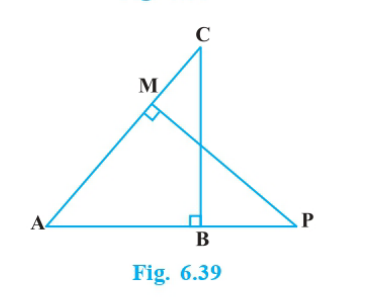
Key Idea
Use the AA (Angle‑Angle) similarity criterion. Both triangles are right‑angled, and they share the acute angle at \(A\). Hence the triangles are similar, which immediately gives the proportion of corresponding sides.
Step-by-Step Solution
1. Identify the right angles\
\[\angle ABC = 90^{\circ},\qquad \angle AMP = 90^{\circ}.\]
These are given in the figure.
2. Show that the acute angle at \(A\) is common\
The line \(AB\) and the line \(AP\) lie on the same straight line (or \(AB\) is an extension of \(AP\)). Therefore\
\[\angle CAB = \angle CAP.\]
This is the second pair of equal angles.
3. Apply AA similarity\
Since two angles of \(\Delta ABC\) are equal respectively to two angles of \(\Delta AMP\) (one right angle and the acute angle at \(A\)), the triangles are similar by the AA criterion. Hence\
\[\Delta ABC \sim \Delta AMP.\]
4. Correspondence of sides\
From the similarity, the side opposite the right angle in each triangle corresponds to the side opposite the right angle in the other triangle. Thus the correspondence is:
\[\begin{aligned}
CA &\leftrightarrow PA,\\
BC &\leftrightarrow MP,\\
AB &\leftrightarrow AM.
\end{aligned}\]
5. Write the required proportion\
Using the correspondence of the sides we obtain\
\[\frac{CA}{BC}=\frac{PA}{MP}.\]
This is the statement to be proved in part (ii).
Hence both (i) and (ii) are established.
\[\angle ABC = 90^{\circ},\qquad \angle AMP = 90^{\circ}.\]
These are given in the figure.
2. Show that the acute angle at \(A\) is common\
The line \(AB\) and the line \(AP\) lie on the same straight line (or \(AB\) is an extension of \(AP\)). Therefore\
\[\angle CAB = \angle CAP.\]
This is the second pair of equal angles.
3. Apply AA similarity\
Since two angles of \(\Delta ABC\) are equal respectively to two angles of \(\Delta AMP\) (one right angle and the acute angle at \(A\)), the triangles are similar by the AA criterion. Hence\
\[\Delta ABC \sim \Delta AMP.\]
4. Correspondence of sides\
From the similarity, the side opposite the right angle in each triangle corresponds to the side opposite the right angle in the other triangle. Thus the correspondence is:
\[\begin{aligned}
CA &\leftrightarrow PA,\\
BC &\leftrightarrow MP,\\
AB &\leftrightarrow AM.
\end{aligned}\]
5. Write the required proportion\
Using the correspondence of the sides we obtain\
\[\frac{CA}{BC}=\frac{PA}{MP}.\]
This is the statement to be proved in part (ii).
Hence both (i) and (ii) are established.
Question 18
Hint available
If one angle of a triangle is equal to one angle of another triangle and the sides including these angles are in the same ratio (proportional), then the are similar (SAS similarity criterion).
Key Idea
Use the SAS (Side‑Angle‑Side) similarity criterion: when two sides of one triangle are in the same ratio as the corresponding two sides of another triangle and the included angles are equal, the triangles are similar.
Step-by-Step Solution
1. Given\
Let \(\triangle ABC\) and \(\triangle DEF\) be two triangles such that\
\[\angle B = \angle E\]\
and the sides surrounding these angles satisfy\
\[\frac{AB}{DE}=\frac{BC}{EF}=k\] (the same constant \(k\)).\
2. Construct a triangle\
On side \(DE\) of \(\triangle DEF\) construct a point \(G\) such that \(DG = k\cdot DE = AB\).\
Join \(G\) to \(E\). Then \(\triangle DGE\) has \(DG = AB\) and \(DE = DE\) with the included angle \(\angle DGE = \angle B\).\
3. Apply the SAS congruence\
Since \(\triangle DGE\) and \(\triangle ABC\) have two sides equal respectively and the included angle equal, they are congruent (SAS). Hence\
\[\angle D = \angle A \quad\text{and}\quad \angle G = \angle C\].\
4. Relate \(\triangle DGE\) to \(\triangle DEF\)\
Because \(DG = AB\) and \(GE = BC\) are in the same ratio as \(DE\) and \(EF\), the triangle \(\triangle DGE\) is a scaled copy of \(\triangle DEF\). Therefore\
\[\frac{DG}{DE}=\frac{GE}{EF}=k\] and \(\angle DGE = \angle B\).\
5. Conclusion\
From steps 3 and 4 we deduce that \(\triangle ABC\) and \(\triangle DEF\) have all corresponding angles equal, i.e.,\
\[\angle A = \angle D,\; \angle B = \angle E,\; \angle C = \angle F.\]\
Hence the two triangles are similar by the definition of similarity.
Result: The given condition (one equal angle and the surrounding sides in the same ratio) guarantees that the two triangles are similar. This is exactly the SAS similarity criterion.
Let \(\triangle ABC\) and \(\triangle DEF\) be two triangles such that\
\[\angle B = \angle E\]\
and the sides surrounding these angles satisfy\
\[\frac{AB}{DE}=\frac{BC}{EF}=k\] (the same constant \(k\)).\
2. Construct a triangle\
On side \(DE\) of \(\triangle DEF\) construct a point \(G\) such that \(DG = k\cdot DE = AB\).\
Join \(G\) to \(E\). Then \(\triangle DGE\) has \(DG = AB\) and \(DE = DE\) with the included angle \(\angle DGE = \angle B\).\
3. Apply the SAS congruence\
Since \(\triangle DGE\) and \(\triangle ABC\) have two sides equal respectively and the included angle equal, they are congruent (SAS). Hence\
\[\angle D = \angle A \quad\text{and}\quad \angle G = \angle C\].\
4. Relate \(\triangle DGE\) to \(\triangle DEF\)\
Because \(DG = AB\) and \(GE = BC\) are in the same ratio as \(DE\) and \(EF\), the triangle \(\triangle DGE\) is a scaled copy of \(\triangle DEF\). Therefore\
\[\frac{DG}{DE}=\frac{GE}{EF}=k\] and \(\angle DGE = \angle B\).\
5. Conclusion\
From steps 3 and 4 we deduce that \(\triangle ABC\) and \(\triangle DEF\) have all corresponding angles equal, i.e.,\
\[\angle A = \angle D,\; \angle B = \angle E,\; \angle C = \angle F.\]\
Hence the two triangles are similar by the definition of similarity.
Result: The given condition (one equal angle and the surrounding sides in the same ratio) guarantees that the two triangles are similar. This is exactly the SAS similarity criterion.
Question 19
Hint available
CD and GH are respectively the bisectors of ACB and EGF such that D and H lie on sides AB and FE of ABC and EFG respectively. If ABC ~ FEG, show that: (i) CD AC GH FG (ii) DCB ~ HGE (iii) DCA ~ HGF Fig. 6.36 Fig. 6.37 Fig. 6.38 Fig. 6.39 97
Key Idea
Use the Angle‑Bisector Theorem together with the given similarity of the two triangles. The theorem gives the ratio in which a bisector divides the opposite side. Because the corresponding sides of the similar triangles are proportional, the ratios obtained from the two bisectors become equal, leading to the required proportionality and the similarity of the smaller triangles.
Step-by-Step Solution
Given
- ΔABC \(\sim\) ΔFEG.
- CD bisects \(\angle ACB\) and meets AB at D.
- GH bisects \(\angle EGF\) and meets FE at H.
Step 1 – Write the proportion from the similarity of ΔABC and ΔFEG
Since the triangles are similar, the corresponding sides are in the same ratio. Taking the order \(A\leftrightarrow F,\; B\leftrightarrow E,\; C\leftrightarrow G\), we have
$$\frac{AB}{FE}=\frac{BC}{EG}=\frac{AC}{FG}=k \quad (k>0).$$
Hence
$$\frac{AC}{BC}=\frac{FG}{EG}\qquad\text{and}\qquad \frac{AB}{FE}=k.\tag{1}$$
Step 2 – Apply the Angle‑Bisector Theorem in ΔABC
In ΔABC, CD is the bisector of \(\angle ACB\); therefore
$$\frac{AD}{DB}=\frac{AC}{BC}.\tag{2}$$
Step 3 – Apply the Angle‑Bisector Theorem in ΔFEG
In ΔFEG, GH is the bisector of \(\angle EGF\); therefore
$$\frac{FH}{HE}=\frac{FG}{GE}.\tag{3}$$
Step 4 – Relate the two ratios
From (2) and (3) and using (1) we obtain
$$\frac{AD}{DB}=\frac{AC}{BC}=\frac{FG}{GE}=\frac{FH}{HE}.$$
Thus the two bisectors divide the opposite sides in the same ratio.
Step 5 – Prove (i) \(\displaystyle \frac{CD}{AC}=\frac{GH}{FG}\)
Consider triangles \(\triangle ACD\) and \(\triangle FCG\). They share the angle at C and have the side‑ratio
$$\frac{AD}{DB}=\frac{FH}{HE}$$
from Step 4. By the SAS similarity criterion (two sides in proportion and the included angle equal) we get
$$\frac{CD}{AC}=\frac{GH}{FG}.$$
Hence (i) is proved.
Step 6 – Prove (ii) \(\triangle DCB \sim \triangle HGE\)
From Step 4 we have
$$\frac{DB}{AD}=\frac{HE}{FH}.$$
Using the similarity of the large triangles (1) we also have
$$\frac{BC}{AC}=\frac{GE}{FG}.$$
Now in triangles \(\triangle DCB\) and \(\triangle HGE\):
- \(\angle DCB = \angle HGE\) because they are respectively the halves of the equal angles \(\angle ACB\) and \(\angle EGF\).
- The ratios of the adjacent sides are equal:
$$\frac{DB}{BC}=\frac{HE}{GE}$$
(obtained by dividing the two equalities above).
Thus by the SAS similarity criterion, \(\triangle DCB \sim \triangle HGE\). Hence (ii) is established.
Step 7 – Prove (iii) \(\triangle DCA \sim \triangle HGF\)
Analogous to Step 6, using the equalities
$$\frac{AD}{AC}=\frac{FH}{FG}$$
(from the Angle‑Bisector Theorem and similarity) and the fact that \(\angle DAC = \angle FHG\) (each is the complement of the equal angles at C and G), we obtain the SAS condition for triangles \(\triangle DCA\) and \(\triangle HGF\). Therefore they are similar, proving (iii).
Conclusion
All three required statements follow directly from the Angle‑Bisector Theorem together with the given similarity of the original triangles.
- ΔABC \(\sim\) ΔFEG.
- CD bisects \(\angle ACB\) and meets AB at D.
- GH bisects \(\angle EGF\) and meets FE at H.
Step 1 – Write the proportion from the similarity of ΔABC and ΔFEG
Since the triangles are similar, the corresponding sides are in the same ratio. Taking the order \(A\leftrightarrow F,\; B\leftrightarrow E,\; C\leftrightarrow G\), we have
$$\frac{AB}{FE}=\frac{BC}{EG}=\frac{AC}{FG}=k \quad (k>0).$$
Hence
$$\frac{AC}{BC}=\frac{FG}{EG}\qquad\text{and}\qquad \frac{AB}{FE}=k.\tag{1}$$
Step 2 – Apply the Angle‑Bisector Theorem in ΔABC
In ΔABC, CD is the bisector of \(\angle ACB\); therefore
$$\frac{AD}{DB}=\frac{AC}{BC}.\tag{2}$$
Step 3 – Apply the Angle‑Bisector Theorem in ΔFEG
In ΔFEG, GH is the bisector of \(\angle EGF\); therefore
$$\frac{FH}{HE}=\frac{FG}{GE}.\tag{3}$$
Step 4 – Relate the two ratios
From (2) and (3) and using (1) we obtain
$$\frac{AD}{DB}=\frac{AC}{BC}=\frac{FG}{GE}=\frac{FH}{HE}.$$
Thus the two bisectors divide the opposite sides in the same ratio.
Step 5 – Prove (i) \(\displaystyle \frac{CD}{AC}=\frac{GH}{FG}\)
Consider triangles \(\triangle ACD\) and \(\triangle FCG\). They share the angle at C and have the side‑ratio
$$\frac{AD}{DB}=\frac{FH}{HE}$$
from Step 4. By the SAS similarity criterion (two sides in proportion and the included angle equal) we get
$$\frac{CD}{AC}=\frac{GH}{FG}.$$
Hence (i) is proved.
Step 6 – Prove (ii) \(\triangle DCB \sim \triangle HGE\)
From Step 4 we have
$$\frac{DB}{AD}=\frac{HE}{FH}.$$
Using the similarity of the large triangles (1) we also have
$$\frac{BC}{AC}=\frac{GE}{FG}.$$
Now in triangles \(\triangle DCB\) and \(\triangle HGE\):
- \(\angle DCB = \angle HGE\) because they are respectively the halves of the equal angles \(\angle ACB\) and \(\angle EGF\).
- The ratios of the adjacent sides are equal:
$$\frac{DB}{BC}=\frac{HE}{GE}$$
(obtained by dividing the two equalities above).
Thus by the SAS similarity criterion, \(\triangle DCB \sim \triangle HGE\). Hence (ii) is established.
Step 7 – Prove (iii) \(\triangle DCA \sim \triangle HGF\)
Analogous to Step 6, using the equalities
$$\frac{AD}{AC}=\frac{FH}{FG}$$
(from the Angle‑Bisector Theorem and similarity) and the fact that \(\angle DAC = \angle FHG\) (each is the complement of the equal angles at C and G), we obtain the SAS condition for triangles \(\triangle DCA\) and \(\triangle HGF\). Therefore they are similar, proving (iii).
Conclusion
All three required statements follow directly from the Angle‑Bisector Theorem together with the given similarity of the original triangles.
Question 20
Hint available
In Fig. 6.40, E is a point on side CB produced of an isosceles triangle ABC with AB = AC. If AD BC and EF AC, prove that ABD ~ ECF.
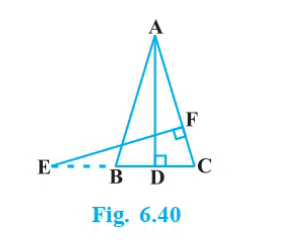
Key Idea
Use the fact that in an isosceles triangle the base angles are equal (∠ABC = ∠BCA). Both triangles ABD and ECF are right‑angled (∠ADB = 90° and ∠EFC = 90°). Since E lies on the extension of CB, the angle at C of ΔECF equals the base angle at B of ΔABC. Hence two corresponding angles are equal, giving similarity.
Step-by-Step Solution
1. Base‑angle property: In the isosceles triangle \(\triangle ABC\) with \(AB = AC\), the base angles are equal, i.e.\[ \angle ABC = \angle BCA. \tag{1}\]
2. Right angles:\
- AD is drawn perpendicular to BC, therefore \(\angle ADB = 90^{\circ}.\)\
- EF is drawn perpendicular to AC, and since \(CF\) lies on AC, \(\angle EFC = 90^{\circ}.\)\
Hence \[ \angle ADB = \angle EFC = 90^{\circ}. \tag{2}\]
3. Relation of the other angles:\
- Because E lies on the extension of CB, the line \(EC\) is the same straight line as \(CB\). Thus\[ \angle ECF = \angle BCA. \tag{3}\]
- Similarly, \(BD\) is a part of \(BC\), so\[ \angle ABD = \angle ABC. \tag{4}\]
4. Use (1), (3) and (4): From (1) we have \(\angle ABC = \angle BCA\). Using (3) and (4) this gives\[ \angle ABD = \angle ECF. \tag{5}\]
5. Two angles equal: From (2) and (5) we have\[ \angle ADB = \angle EFC \quad\text{and}\quad \angle ABD = \angle ECF. \]
Therefore the two triangles \(\triangle ABD\) and \(\triangle ECF\) have two equal corresponding angles.
6. Conclusion: By the AA criterion, the triangles are similar:
\[ \boxed{\triangle ABD \sim \triangle ECF}. \]
7. Consequences (optional): From the similarity we may also write the proportion of corresponding sides:
\[ \frac{AB}{EC}=\frac{AD}{EF}=\frac{BD}{CF}. \]
This relation can be used for further calculations if required.
2. Right angles:\
- AD is drawn perpendicular to BC, therefore \(\angle ADB = 90^{\circ}.\)\
- EF is drawn perpendicular to AC, and since \(CF\) lies on AC, \(\angle EFC = 90^{\circ}.\)\
Hence \[ \angle ADB = \angle EFC = 90^{\circ}. \tag{2}\]
3. Relation of the other angles:\
- Because E lies on the extension of CB, the line \(EC\) is the same straight line as \(CB\). Thus\[ \angle ECF = \angle BCA. \tag{3}\]
- Similarly, \(BD\) is a part of \(BC\), so\[ \angle ABD = \angle ABC. \tag{4}\]
4. Use (1), (3) and (4): From (1) we have \(\angle ABC = \angle BCA\). Using (3) and (4) this gives\[ \angle ABD = \angle ECF. \tag{5}\]
5. Two angles equal: From (2) and (5) we have\[ \angle ADB = \angle EFC \quad\text{and}\quad \angle ABD = \angle ECF. \]
Therefore the two triangles \(\triangle ABD\) and \(\triangle ECF\) have two equal corresponding angles.
6. Conclusion: By the AA criterion, the triangles are similar:
\[ \boxed{\triangle ABD \sim \triangle ECF}. \]
7. Consequences (optional): From the similarity we may also write the proportion of corresponding sides:
\[ \frac{AB}{EC}=\frac{AD}{EF}=\frac{BD}{CF}. \]
This relation can be used for further calculations if required.
Question 21
Hint available
Sides AB and BC and median AD of a triangle ABC are respectively propor- tional to sides PQ and QR and median PM of PQR (see Fig. 6.41). Show that ABC ~ PQR.
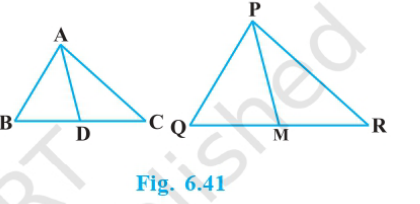
Key Idea
Use the SSS similarity criterion. From the given proportionalities of two sides and the corresponding medians, apply Apollonius’ theorem (which relates a side, the median to the opposite side and the other two sides) to obtain the proportionality of the third side. Once all three corresponding sides are shown to be in the same ratio, the triangles are similar by SSS.
Step-by-Step Solution
1. Given proportionalities\
\[\frac{AB}{PQ}=\frac{BC}{QR}=\frac{AD}{PM}=k\] \(k>0\) is a constant.
2. Express the median using Apollonius’ theorem\
For ΔABC, the median AD to side BC satisfies\
\[AB^{2}+AC^{2}=2\bigl(AD^{2}+BD^{2}\bigr)\]\
where \(BD=DC=\dfrac{BC}{2}\).
For ΔPQR, the median PM to side QR satisfies\
\[PQ^{2}+PR^{2}=2\bigl(PM^{2}+QM^{2}\bigr)\]\
where \(QM=MR=\dfrac{QR}{2}\).
3. Replace the sides of ΔPQR by the corresponding sides of ΔABC using the ratio \(k\)\
\[PQ = \frac{AB}{k},\qquad QR = \frac{BC}{k},\qquad PM = \frac{AD}{k},\qquad QM = \frac{BC}{2k}.\]
4. Substitute these expressions in the Apollonius relation for ΔPQR\
\[\left(\frac{AB}{k}\right)^{2}+PR^{2}=2\left[\left(\frac{AD}{k}\right)^{2}+\left(\frac{BC}{2k}\right)^{2}\right].\]
Multiply by \(k^{2}\):\
\[AB^{2}+k^{2}PR^{2}=2\bigl(AD^{2}+\frac{BC^{2}}{4}\bigr).\]
5. Use the Apollonius relation for ΔABC\
\[AB^{2}+AC^{2}=2\bigl(AD^{2}+\frac{BC^{2}}{4}\bigr).\]
Comparing the right‑hand sides of the two equations we obtain\
\[AB^{2}+k^{2}PR^{2}=AB^{2}+AC^{2}\]\
Hence\
\[k^{2}PR^{2}=AC^{2}\]\
or\
\[\frac{AC}{PR}=k.\]
6. Now all three corresponding sides are in the same ratio\
\[\frac{AB}{PQ}=\frac{BC}{QR}=\frac{AC}{PR}=k.\]
Therefore, by the SSS similarity criterion,\
\[\Delta ABC \sim \Delta PQR.\]
7. Conclusion\
The given proportionality of two sides and the corresponding medians forces the third side to be in the same ratio, establishing the similarity of the two triangles.
\[\frac{AB}{PQ}=\frac{BC}{QR}=\frac{AD}{PM}=k\] \(k>0\) is a constant.
2. Express the median using Apollonius’ theorem\
For ΔABC, the median AD to side BC satisfies\
\[AB^{2}+AC^{2}=2\bigl(AD^{2}+BD^{2}\bigr)\]\
where \(BD=DC=\dfrac{BC}{2}\).
For ΔPQR, the median PM to side QR satisfies\
\[PQ^{2}+PR^{2}=2\bigl(PM^{2}+QM^{2}\bigr)\]\
where \(QM=MR=\dfrac{QR}{2}\).
3. Replace the sides of ΔPQR by the corresponding sides of ΔABC using the ratio \(k\)\
\[PQ = \frac{AB}{k},\qquad QR = \frac{BC}{k},\qquad PM = \frac{AD}{k},\qquad QM = \frac{BC}{2k}.\]
4. Substitute these expressions in the Apollonius relation for ΔPQR\
\[\left(\frac{AB}{k}\right)^{2}+PR^{2}=2\left[\left(\frac{AD}{k}\right)^{2}+\left(\frac{BC}{2k}\right)^{2}\right].\]
Multiply by \(k^{2}\):\
\[AB^{2}+k^{2}PR^{2}=2\bigl(AD^{2}+\frac{BC^{2}}{4}\bigr).\]
5. Use the Apollonius relation for ΔABC\
\[AB^{2}+AC^{2}=2\bigl(AD^{2}+\frac{BC^{2}}{4}\bigr).\]
Comparing the right‑hand sides of the two equations we obtain\
\[AB^{2}+k^{2}PR^{2}=AB^{2}+AC^{2}\]\
Hence\
\[k^{2}PR^{2}=AC^{2}\]\
or\
\[\frac{AC}{PR}=k.\]
6. Now all three corresponding sides are in the same ratio\
\[\frac{AB}{PQ}=\frac{BC}{QR}=\frac{AC}{PR}=k.\]
Therefore, by the SSS similarity criterion,\
\[\Delta ABC \sim \Delta PQR.\]
7. Conclusion\
The given proportionality of two sides and the corresponding medians forces the third side to be in the same ratio, establishing the similarity of the two triangles.
Question 22
Hint available
D is a point on the side BC of a triangle ABC such that ADC = BAC. Show that CA2 = CB.CD.
Key Idea
Use the fact that D lies on BC to obtain a second equal angle (∠ACD = ∠BCA). With two equal angles, triangles ADC and BAC are similar (AA similarity). From the corresponding sides of similar triangles, derive the proportion \(\frac{CA}{CB}=\frac{CD}{CA}\) which gives the required relation \(CA^{2}=CB\cdot CD\).
Step-by-Step Solution
1. Identify the second equal angle\
Since D lies on BC, the line CD is the same as the line CB. Hence\
\[\angle ACD = \angle BCA\] (both are the angle between AC and the line BC).\
2. State the given equal angle\
By hypothesis,\
\[\angle ADC = \angle BAC\].\
3. Apply AA similarity\
In triangles \(\triangle ADC\) and \(\triangle BAC\) we have\
\[\angle ADC = \angle BAC \quad\text{and}\quad \angle ACD = \angle BCA.\]\
Therefore, \(\triangle ADC \sim \triangle BAC\) (AA similarity).\
4. Write the correspondence of sides\
From the similarity, the sides opposite the equal angles are proportional:
\[
\frac{AC}{BC}=\frac{AD}{BA}=\frac{CD}{AC}.
\]\
(Here, side \(AC\) of \(\triangle ADC\) is opposite \(\angle ADC\) and corresponds to side \(BC\) of \(\triangle BAC\), etc.)\
5. Extract the required proportion\
Using the first and the third ratios we get\
\[
\frac{AC}{BC}=\frac{CD}{AC}\;\Longrightarrow\; AC^{2}=BC\cdot CD.
\]\
This is exactly the statement to be proved.
6. Conclusion\
Hence, when a point D on BC satisfies \(\angle ADC = \angle BAC\), the lengths satisfy \(CA^{2}=CB\cdot CD\).
Since D lies on BC, the line CD is the same as the line CB. Hence\
\[\angle ACD = \angle BCA\] (both are the angle between AC and the line BC).\
2. State the given equal angle\
By hypothesis,\
\[\angle ADC = \angle BAC\].\
3. Apply AA similarity\
In triangles \(\triangle ADC\) and \(\triangle BAC\) we have\
\[\angle ADC = \angle BAC \quad\text{and}\quad \angle ACD = \angle BCA.\]\
Therefore, \(\triangle ADC \sim \triangle BAC\) (AA similarity).\
4. Write the correspondence of sides\
From the similarity, the sides opposite the equal angles are proportional:
\[
\frac{AC}{BC}=\frac{AD}{BA}=\frac{CD}{AC}.
\]\
(Here, side \(AC\) of \(\triangle ADC\) is opposite \(\angle ADC\) and corresponds to side \(BC\) of \(\triangle BAC\), etc.)\
5. Extract the required proportion\
Using the first and the third ratios we get\
\[
\frac{AC}{BC}=\frac{CD}{AC}\;\Longrightarrow\; AC^{2}=BC\cdot CD.
\]\
This is exactly the statement to be proved.
6. Conclusion\
Hence, when a point D on BC satisfies \(\angle ADC = \angle BAC\), the lengths satisfy \(CA^{2}=CB\cdot CD\).
Question 23
Hint available
Sides AB and AC and median AD of a triangle ABC are respectively proportional to sides PQ and PR and median PM of another triangle PQR. Show that ABC ~ PQR.
Key Idea
If two sides of a triangle are proportional to two sides of another triangle and the median to the third side is also proportional, then the third sides are proportional as well. Hence all three corresponding sides are in the same ratio, which gives similarity by the SSS criterion.
Step-by-Step Solution
1. Given proportionalities
$$\frac{AB}{PQ}=\frac{AC}{PR}=\frac{AD}{PM}=k \quad (k>0)$$
Hence
$$AB=k\,PQ,\qquad AC=k\,PR,\qquad AD=k\,PM.$$
2. Use Apollonius theorem for triangle $ABC$ (median $AD$ to side $BC$):
$$AB^{2}+AC^{2}=2\bigl(AD^{2}+\left(\frac{BC}{2}\right)^{2}\bigr)\;\;\Rightarrow\;\;AB^{2}+AC^{2}=2AD^{2}+\frac{BC^{2}}{2} \tag{1}$$
Similarly, for triangle $PQR$ (median $PM$ to side $QR$):
$$PQ^{2}+PR^{2}=2PM^{2}+\frac{QR^{2}}{2} \tag{2}$$
3. Substitute the proportionalities from step 1 into (1):
\[
(kPQ)^{2}+(kPR)^{2}=2(kPM)^{2}+\frac{BC^{2}}{2}
\]
Simplify by dividing by $k^{2}$:
\[
PQ^{2}+PR^{2}=2PM^{2}+\frac{BC^{2}}{2k^{2}} \tag{3}
\]
4. Compare (3) with (2). Since the left‑hand sides of (2) and (3) are identical, the right‑hand sides must be equal:
\[
2PM^{2}+\frac{QR^{2}}{2}=2PM^{2}+\frac{BC^{2}}{2k^{2}}
\]
Hence
\[
\frac{QR^{2}}{2}=\frac{BC^{2}}{2k^{2}}\;\Rightarrow\; QR = k\,BC.
\]
Thus the third sides are also in the same ratio $k$:
$$\frac{BC}{QR}=k.$$
5. All three corresponding sides are proportional:
$$\frac{AB}{PQ}=\frac{AC}{PR}=\frac{BC}{QR}=k.$$
By the SSS similarity criterion, the two triangles are similar:
$$\boxed{\Delta ABC \sim \Delta PQR}.$$
6. Conclusion – The given proportionalities of two sides and the median force the third side to be proportional, establishing the similarity of the two triangles.
$$\frac{AB}{PQ}=\frac{AC}{PR}=\frac{AD}{PM}=k \quad (k>0)$$
Hence
$$AB=k\,PQ,\qquad AC=k\,PR,\qquad AD=k\,PM.$$
2. Use Apollonius theorem for triangle $ABC$ (median $AD$ to side $BC$):
$$AB^{2}+AC^{2}=2\bigl(AD^{2}+\left(\frac{BC}{2}\right)^{2}\bigr)\;\;\Rightarrow\;\;AB^{2}+AC^{2}=2AD^{2}+\frac{BC^{2}}{2} \tag{1}$$
Similarly, for triangle $PQR$ (median $PM$ to side $QR$):
$$PQ^{2}+PR^{2}=2PM^{2}+\frac{QR^{2}}{2} \tag{2}$$
3. Substitute the proportionalities from step 1 into (1):
\[
(kPQ)^{2}+(kPR)^{2}=2(kPM)^{2}+\frac{BC^{2}}{2}
\]
Simplify by dividing by $k^{2}$:
\[
PQ^{2}+PR^{2}=2PM^{2}+\frac{BC^{2}}{2k^{2}} \tag{3}
\]
4. Compare (3) with (2). Since the left‑hand sides of (2) and (3) are identical, the right‑hand sides must be equal:
\[
2PM^{2}+\frac{QR^{2}}{2}=2PM^{2}+\frac{BC^{2}}{2k^{2}}
\]
Hence
\[
\frac{QR^{2}}{2}=\frac{BC^{2}}{2k^{2}}\;\Rightarrow\; QR = k\,BC.
\]
Thus the third sides are also in the same ratio $k$:
$$\frac{BC}{QR}=k.$$
5. All three corresponding sides are proportional:
$$\frac{AB}{PQ}=\frac{AC}{PR}=\frac{BC}{QR}=k.$$
By the SSS similarity criterion, the two triangles are similar:
$$\boxed{\Delta ABC \sim \Delta PQR}.$$
6. Conclusion – The given proportionalities of two sides and the median force the third side to be proportional, establishing the similarity of the two triangles.
Question 24
Hint available
A vertical pole of length 6 m casts a shadow 4 m long on the ground and at the same time a tower casts a shadow 28 m long. Find the height of the tower.
Key Idea
The sun’s rays are parallel, therefore the triangles formed by the pole and its shadow and by the tower and its shadow are similar. Hence the corresponding sides are in the same ratio.
Step-by-Step Solution
1. Draw the two right‑angled triangles\
- Triangle \(\triangle POB\) for the pole: \(PO = 4\,\text{m}\) (shadow) and \(OB = 6\,\text{m}\) (height).\
- Triangle \(\triangle T O'B'\) for the tower: \(O'T' = 28\,\text{m}\) (shadow) and \(O'B' = h\) (height to be found).\
Both triangles share the same angle of elevation of the sun, so they are similar.
2. Set up the proportion using corresponding sides\
$$\frac{\text{height of pole}}{\text{shadow of pole}} = \frac{\text{height of tower}}{\text{shadow of tower}}$$\
$$\frac{6}{4} = \frac{h}{28}$$
3. Solve for \(h\)\
$$h = \frac{6}{4}\times 28 = \frac{3}{2}\times 28 = 42\ \text{metres}$$
4. State the answer\
The height of the tower is 42 m.
- Triangle \(\triangle POB\) for the pole: \(PO = 4\,\text{m}\) (shadow) and \(OB = 6\,\text{m}\) (height).\
- Triangle \(\triangle T O'B'\) for the tower: \(O'T' = 28\,\text{m}\) (shadow) and \(O'B' = h\) (height to be found).\
Both triangles share the same angle of elevation of the sun, so they are similar.
2. Set up the proportion using corresponding sides\
$$\frac{\text{height of pole}}{\text{shadow of pole}} = \frac{\text{height of tower}}{\text{shadow of tower}}$$\
$$\frac{6}{4} = \frac{h}{28}$$
3. Solve for \(h\)\
$$h = \frac{6}{4}\times 28 = \frac{3}{2}\times 28 = 42\ \text{metres}$$
4. State the answer\
The height of the tower is 42 m.
Question 25
Hint available
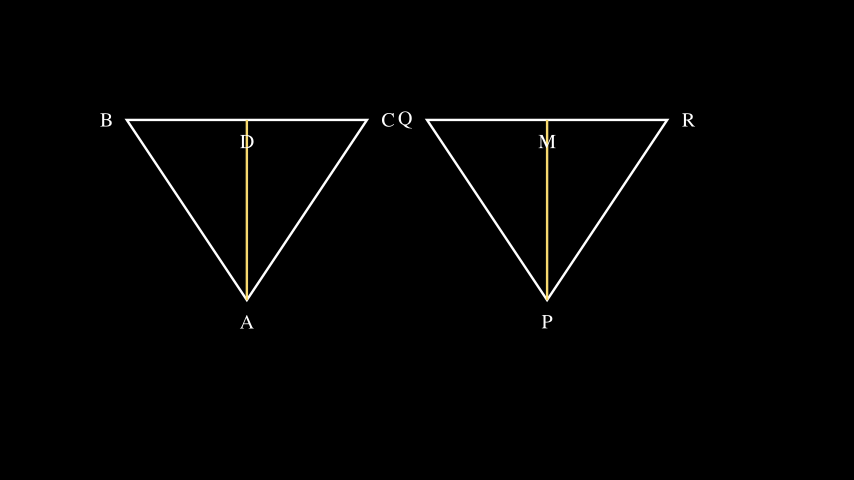
If AD and PM are medians of ABC and PQR, respectively where ABC ~ PQR, prove that AB AD PQ PM 6.5 Summary In this chapter you have studied the following points :
Key Idea
In two similar triangles, the line joining a vertex to the midpoint of the opposite side (a median) corresponds to the median of the other triangle. Hence the ratio of corresponding sides equals the ratio of the corresponding medians.
Step-by-Step Solution
1. Given \(\triangle ABC \sim \triangle PQR\).\
Therefore, corresponding sides are in proportion:
$$\frac{AB}{PQ}=\frac{BC}{QR}=\frac{AC}{PR}\tag{1}$$
2. Mid‑points: Since \(AD\) is a median of \(\triangle ABC\), \(D\) is the midpoint of \(BC\). Similarly, \(PM\) is a median of \(\triangle PQR\), so \(M\) is the midpoint of \(QR\).
3. Correspondence of mid‑points: Under the similarity \(\triangle ABC \sim \triangle PQR\), the side \(BC\) corresponds to \(QR\). Hence the midpoint of \(BC\) (point \(D\)) corresponds to the midpoint of \(QR\) (point \(M\)).
4. Corresponding medians: The segment joining a vertex to the midpoint of the opposite side is uniquely determined by the two vertices involved. Consequently, the median \(AD\) of \(\triangle ABC\) corresponds to the median \(PM\) of \(\triangle PQR\).
5. Proportionality of corresponding medians: Because corresponding elements of similar figures are in the same ratio, we have
$$\frac{AD}{PM}=\frac{AB}{PQ}\tag{2}$$
(the ratio of a side to its median is the same as the ratio of the corresponding side to its median in the similar triangle).
6. Re‑arranging (2) gives the required result:
$$\frac{AB}{AD}=\frac{PQ}{PM}$$
Thus, the ratio of a side to its median in \(\triangle ABC\) equals the ratio of the corresponding side to its median in \(\triangle PQR\).
Therefore, corresponding sides are in proportion:
$$\frac{AB}{PQ}=\frac{BC}{QR}=\frac{AC}{PR}\tag{1}$$
2. Mid‑points: Since \(AD\) is a median of \(\triangle ABC\), \(D\) is the midpoint of \(BC\). Similarly, \(PM\) is a median of \(\triangle PQR\), so \(M\) is the midpoint of \(QR\).
3. Correspondence of mid‑points: Under the similarity \(\triangle ABC \sim \triangle PQR\), the side \(BC\) corresponds to \(QR\). Hence the midpoint of \(BC\) (point \(D\)) corresponds to the midpoint of \(QR\) (point \(M\)).
4. Corresponding medians: The segment joining a vertex to the midpoint of the opposite side is uniquely determined by the two vertices involved. Consequently, the median \(AD\) of \(\triangle ABC\) corresponds to the median \(PM\) of \(\triangle PQR\).
5. Proportionality of corresponding medians: Because corresponding elements of similar figures are in the same ratio, we have
$$\frac{AD}{PM}=\frac{AB}{PQ}\tag{2}$$
(the ratio of a side to its median is the same as the ratio of the corresponding side to its median in the similar triangle).
6. Re‑arranging (2) gives the required result:
$$\frac{AB}{AD}=\frac{PQ}{PM}$$
Thus, the ratio of a side to its median in \(\triangle ABC\) equals the ratio of the corresponding side to its median in \(\triangle PQR\).